

How the waves work
Three things the wave pattern changes.
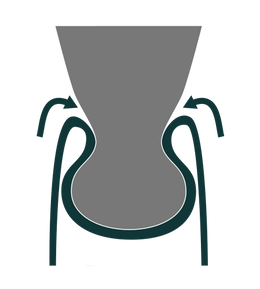
 Enhanced stretchThe Waves pattern artificially increases the circumference to have more textile material, thereby increasing the stretchability of the liner.
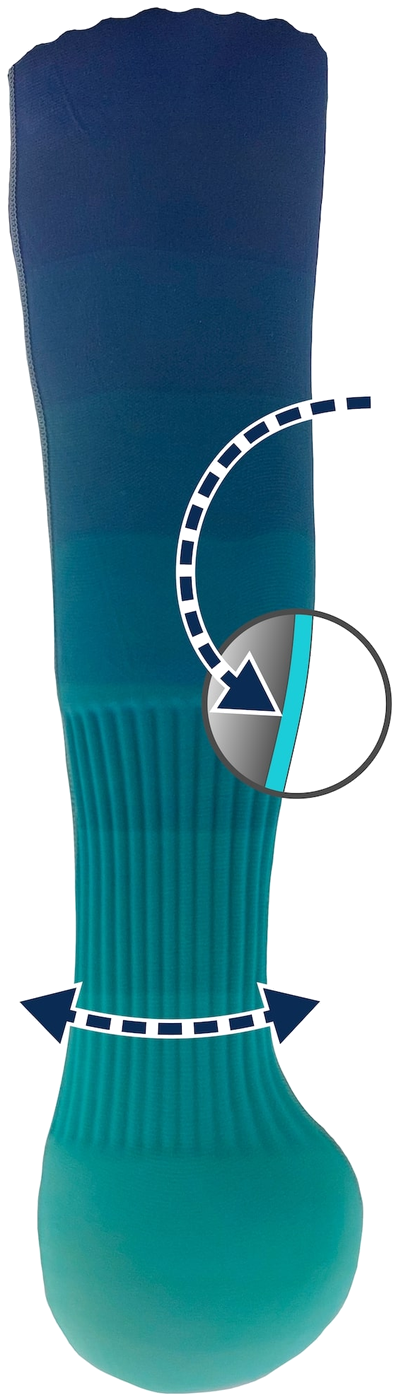
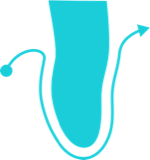 Smooth inside surfaceThe wave pattern is only on the outside surface. The inside surface remains smooth and continuous.
 Waves = donning enablerThe stretchy segment with Waves can more easily go over the prominent distal end when donning the liner.
For what indications?
Built for the hardest-to-fit limbs.
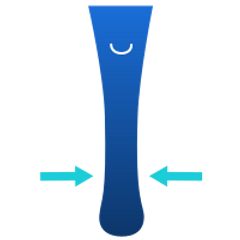
Ankle disarticulation
Symes, Chopart, Pirogoff — a prominent distal end with a narrow ankle segment.
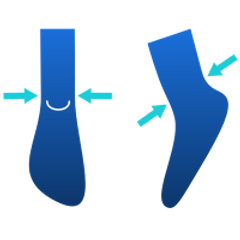
Feet
Borggreve, Van Ness, PFFD — where the ankle segment struggles to stretch over the heel.
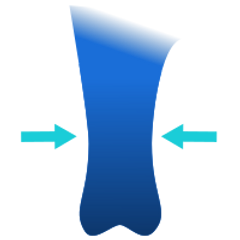
Knee disarticulation
Large femoral condyles where compensation is not feasible.
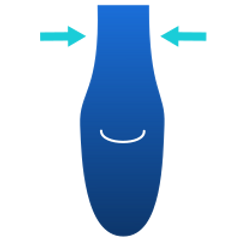
Atrophied thigh
A narrow proximal segment that can be hard to don over the knee.
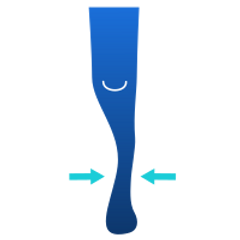
Congenital
Protruding areas and pear shapes that make donning difficult.
Smooth inside surface
The waves are only on the outside — the inner surface stays smooth and continuous against the skin.
Enhanced stretch
The wave pattern adds textile circumference, increasing the stretchability of the liner.
A donning enabler
The stretchy waved segment slips more easily over a prominent distal end when donning.
The approaches
Four ways to fit a pear-shaped limb.
Fully-compensated
Fills the distal shape so limb + liner is cylindrical.
- Works with classical sockets
- Enables vacuum suspension
- Extreme pear-shapes need thick, less-elastic walls
Non-compensated
Follows the limb shape; thickness is constant or tapered.
- Used with modular or soft sockets
- Lower distal bulk
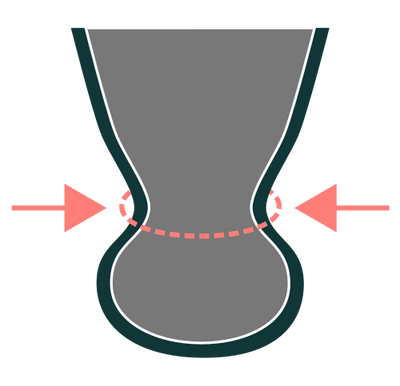
- Textile stretch limit (~30%) can prevent donning
Half-compensated
A middle ground — partial compensation.
- Balances wall thickness against the stretch limit
- Less distal bulk than fully-compensated
Vertical Waves liner
The wave pattern adds textile material for extra stretch.
- Stretches over the narrowest segment
- Makes the hardest pear-shapes donnable
- Smooth inside surface against the skin
Where the classical types reach their donning limit, Vertical Waves makes the fit possible.
The two classical types — and their limits
Fills the distal segment so limb + liner is cylindrical — works with classical sockets and enables vacuum suspension.
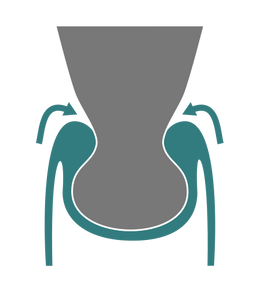
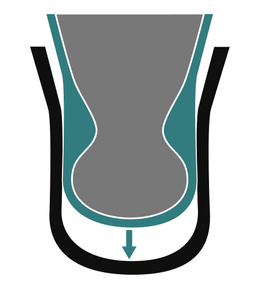
✗ Limited by wall thickness
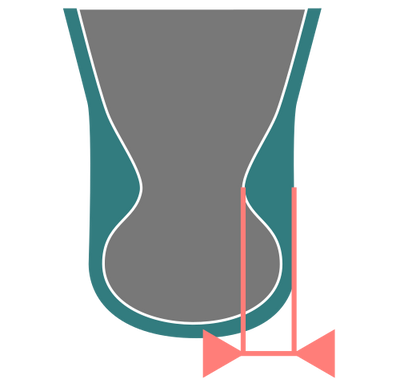
Follows the limb shape — used with modular or soft sockets, with lower distal bulk.
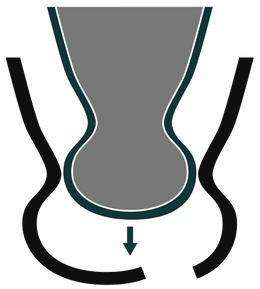
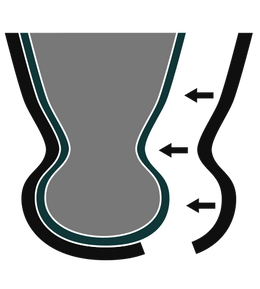
✗ Limited by ~30% textile stretch
To overcome these limits: Type 3 — Half-compensated and Type 4 — Vertical Waves. The four types compared:
Vertical Waves: the go-to solution for easy donning
Which liner type for your patient?
Calculate the stretch percentage — stretch = (max − min) ÷ min — then read across for the recommended liner type.
A simplification — our experts can advise on a case-by-case basis.
Documentation
Further documentation on Vertical Waves.
The official documents for Vertical Waves — Instructions for Use (multilingual) and regulatory notes.
Instructions for use (PDF) ↓ Regulatory notes for prosthetists (PDF) ↓