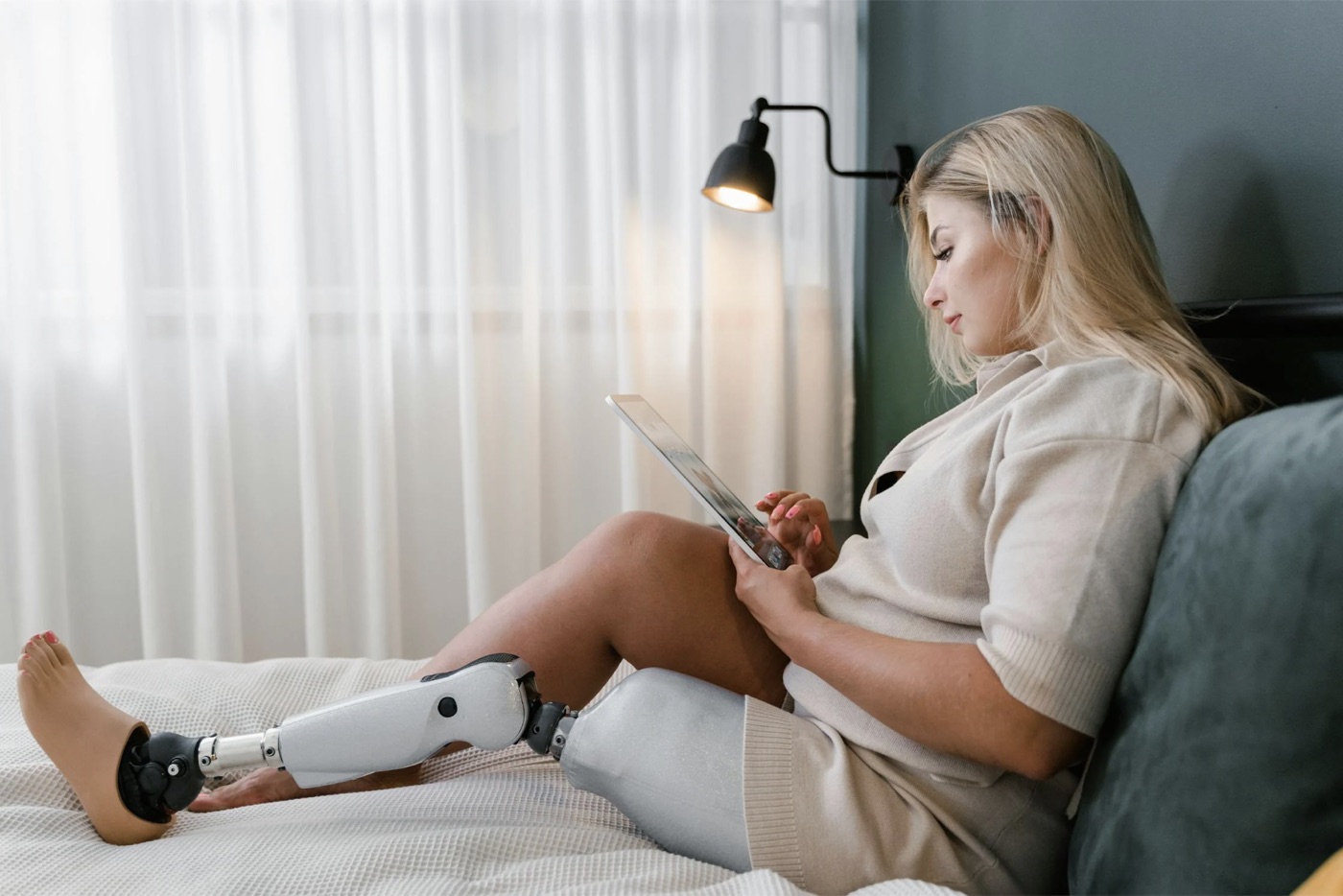
Using a prosthetic leg is rarely a linear journey. Indeed, many users see their limb situation evolving over time, leading to a constant need to adapt their prosthesis to keep them walking.
Your® Liner, as an editable custom solution, can play a fundamental role to help users through the evolutions of their limb situation. Let’s look at how!
Why an evolutive solution?
Liners typically have a much shorter renewal cycle than sockets. As Your® Liner is made through a fully digital process, each renewal is an opportunity to improve, upgrade and adapt the liner to better fit the user’s needs and how these evolve.
But what exactly can you do, and why are we talking about an evolutive solution?
Scan comparison for variation detection
Scans taken some time apart can be compared to analyse the shape and volume variation. To a certain extent, these variations can be compensated for by changes in the liner’s 3D shape.
Thickness editability
As the 3D modelling is fully digital, thicknesses can be controlled very accurately, and modified to compensate a shape variation or improve function.
Reductions editability
Reductions can also be edited to adapt compressions. More importantly: this can be done whilst keeping identical thicknesses in order to maintain an identical socket fit.
Hardness editability
The silicone type can be changed from one liner to the next. With DualShore liners, the hardness change can even be made for a defined local area only.
Suspension editability
Our suspension systems are modular and can be made mutually retro-compatible. Switch suspensions without starting from scratch!
Combined, these features offer unrivalled flexibility
All these features create a highly adaptable, evolutive prosthetic liner that offers:
- Precise adjustments for changing limb conditions
- Possibilities to better maintain user comfort over time
- A potentially increased lifetime for the socket
Typical limb evolution patterns
Here are some quick examples of typical evolutions, and of how the adaptability of Your® Liner can help improve those situations.
Limb volume increases
The socket feels too tight due to increased limb volume. Reduce liner thickness to create more space in the socket.
Limb volume loss
The socket feels loose, leading to increased movement in the socket. Increase liner thickness to compensate for the lost volume.
New sensitivity appears
The patient experiences pain in a new area, for example due to a bone starting to surface under the skin. Keep the thicknesses identical, whilst applying a lower hardness in this location for more comfort.
Limb growth (paediatrics)
A growing child no longer fits the socket, but doesn’t qualify to receive a new one. Reduce liner thickness to maintain usability for longer.
The actual benefits: why choose an evolutive liner?
Your® Liner’s adaptability brings major advantages:
- Delay the need for a new socket
- Keep prosthetic fit even if the limb evolves
- More flexibility to solve arising issues
Thanks to the evolutivity of Your® Liner, you may well be able to delay the need to make a new socket, and save the associated costs.
Even if the limb changes, the editability of Your® Liner can help maintain a good prosthetic fit through those evolutions.
All in all, Your® Liner simply gives CPOs more strings to their bows to face the challenges of constantly-evolving prosthetic fittings.
Final thoughts: future-proofing prosthetic care
With Your® Liner, prosthetic users may not need to start from scratch every time their limb changes. Of course, the liner can’t compensate for everything, and using Your® Liner will not mean that one socket fits forever.
But being able to adjust the liner might help bridge the gap between successive sockets, and help users enjoy a comfortable fit for longer.
The endless configuration possibilities that Your® Liner offers also enable many ways to enhance long-term prosthetic care — from liners with different hardnesses or suspension systems for different activities, to ensuring all such liners are compatible with sockets made for various uses.
Digital liner-making remains in its early years, but it already brings not only promises, but concrete day-to-day improvements for a better quality of life.