
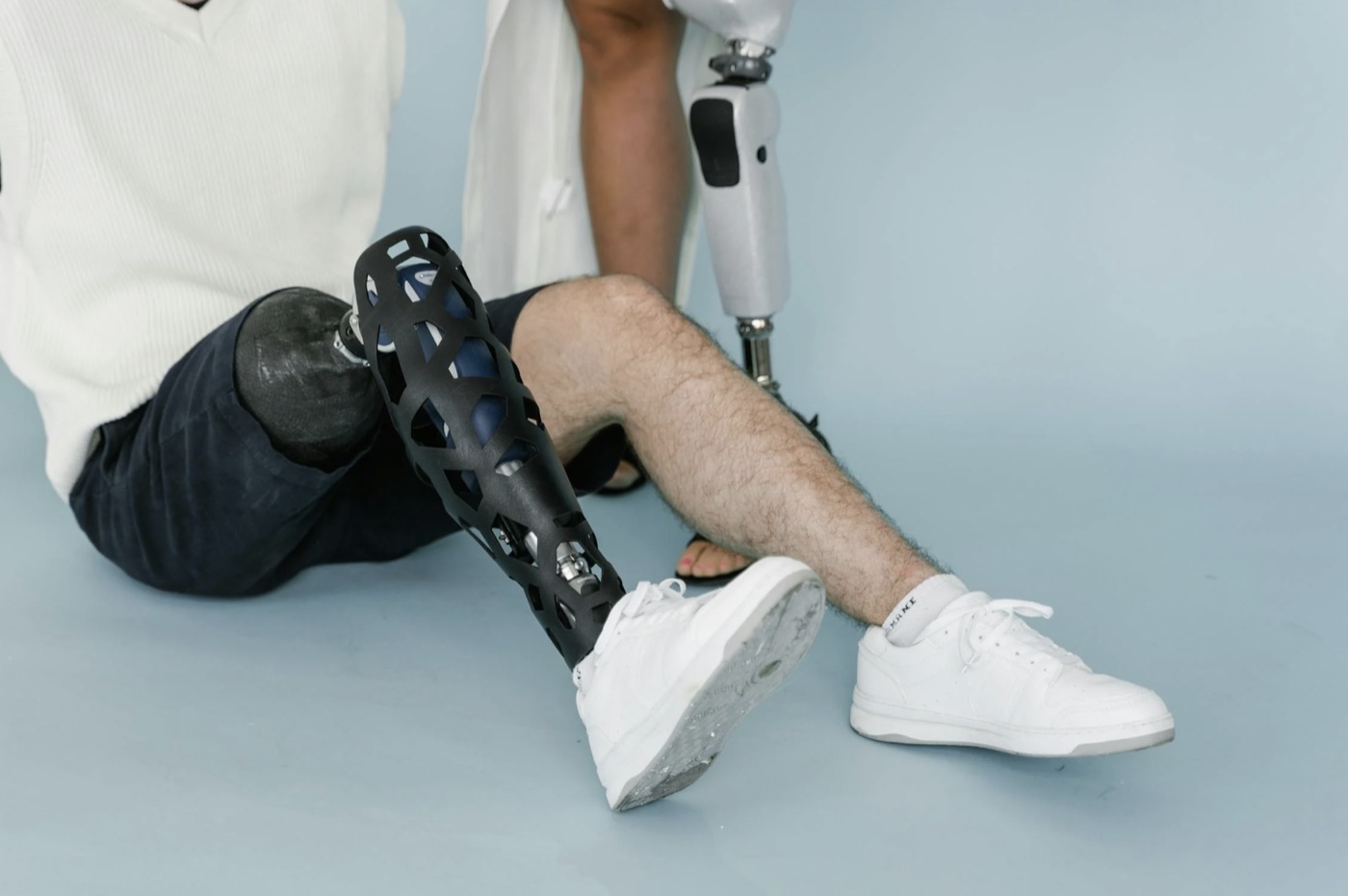
In our field, “custom liner” can mean a lot of things… Thermoformable. Custom inner shape but standard outer shape. Custom shape but uniform thicknesses. Injected. Calendered… Although they present very different characteristics, all these products are referred to as a “custom liner”.
So let’s break down the most common manufacturing methods to see more clearly through these differences.
Not all custom liners are created equal
When we say “custom liners”, it’s easy to assume they’re all the same — but the reality is far more diverse. Depending on the manufacturing method, each type of custom liner offers distinct features and limitations.
1 · Injected liners
The original way to produce a custom liner consists in making a custom mould into which silicone (or another polymer) is injected.
How it works
First, a physical positive model copying the shape of the limb is made — historically by plaster casting, but also by scanning the limb and carving a foam material, 3D-printing a positive model, etc. This positive model serves as the inside mould component.
Second, a sacrificial layer, typically a foam-type material, is applied onto the positive model and ground to obtain the desired liner thickness.
Third, an outside mould component is made, typically by vacuum-forming a thick thermoplastic sheet onto the positive + sacrificial layer.
Finally, the sacrificial foam layer is removed, leaving an empty space between the positive cast and the outer thermoplastic shell, into which silicone (or another polymer) is injected.
Pros
- Local thickness can be controlled, although accuracy depends on the mould-making method
- Can provide a very good fit
Cons
- Once the mould is made, the liner shape can not be modified to follow the evolution of the limb
- Depending on the mould-making method, shape repeatability can be problematic
2 · Thermoformable liners
Another traditional way to obtain a custom liner is to work with a liner whose elastomer layer is made of a thermoformable material.
How it works
First, a physical positive model copying the shape of the limb is made (by plaster casting, scanning and carving foam, 3D printing, etc.).
Second, the liner is placed on the physical copy of the limb and heated for a while. Under the heat, the thermoformable material takes the shape of the limb copy and retains it after cooling down.
Pros
- Quick and easy to adjust
- Affordable solution
Cons
- Final shape can only change to a limited extent from the original liner shape — some limbs can therefore not be fitted
- Thicknesses are not customisable
3 · Custom inside & standard outside
Used by some manufacturers, this process is an evolution of the original injection method, offering a hybrid custom/standard solution.
The inside surface of the liner is made to fit the limb shape, while the outer surface presents a standard shape. This standard outer shape facilitates the fitting of a fabric cover and suspension elements, and helps obtain industrial-grade results.
How it works
First, a 3D scan of the limb is taken.
Second, the scan is modified to fit a “standardised” outer shape, according to available outer mould sizes. This shape is produced (for example by foam carving) to make an inside mould.
Third, the inside mould component is fitted into the standard outer mould component, and the liner is injected.
Pros
- Good fit thanks to the custom inside shape
- Industrial-grade solution enabling quality products at affordable production costs
Cons
- Thicknesses result from standard-outside / custom-inside — they can not be controlled locally
- Can not fit all limb shapes: limited by the available standardised outer moulds
4 · HTV silicone liners
Another well-known type of custom liner is made of “HTV” (high-temperature vulcanizing) silicone. This silicone comes in a paste form and is therefore not injected, but applied in sheets on a positive model to obtain the desired shape and thicknesses.
How it works
First, a positive model of the limb is created.
Second, the HTV silicone (sometimes called HCR) is calendered (rolled out) between two rolls to obtain a sheet of paste-like material. Adjusting the gap between the rolls controls the sheet thickness.
Third, the sheet(s) are applied onto the positive model. Several layers can be applied to vary the thickness.
Pros
- Very good durability
- Suitable for patients with high pressure-tolerance, where the limb has no sensitive areas
Cons
- Thicknesses can’t be copied once the liner is worn out — repeatability is limited
- Hardness is typically much higher, leading to less cushioning / comfort and harder donning
5 · Our solution: 3D-printed silicone liners
Based on the observation that every available method sometimes fell short, MotionTech developed a proprietary silicone 3D-printing technology able to print silicone liners.
It was developed specifically to answer the challenges of making prosthetic liners — accurately printing tall objects made of thin walls and soft materials.
Local thicknesses and hardness can be varied, and the final product can be reproduced with sub-millimetre accuracy.
With this, Your® Liner launched in Europe in 2020. The unique possibilities the technology brings were met with strong enthusiasm and adoption.
How it works
First, a 3D scan of the limb is taken. The prosthetist configures the liner through MotionTech’s ordering platform — hardness, thicknesses, suspension configuration, aesthetic customisation, and more.
Second, starting from the scan, MotionTech’s CAD team creates the 3D model of the liner. The shape is submitted to the prosthetist for validation to ensure the expected features are well implemented.
Finally, the model is printed and post-processed to obtain the final custom liner.
So, what really changes?
Although all of these liners fall under the “custom” umbrella, their capabilities vary dramatically depending on how they’re made — from comfort and roll-on ability to the possibility of adjusting thicknesses or renewing a liner in the future.
That’s why it’s essential to look beyond the label and understand the real capabilities of each technology.
Final thoughts
Not all custom liners are created equal. While traditional methods still serve important roles, newer technologies like 3D silicone printing offer new levels of adaptability, accuracy and patient-centred design.
Whether you’re a prosthetist deciding on the best solution or a patient trying to understand your options, the key is to look deeper. Ask: what do I need from this liner? What matters most — thickness control? Repeatability? Cost? Long-term editability? Local durometer control?
At MotionTech, when we say custom, we mean 100% custom. But custom shouldn’t come at the expense of quality — Your® Liner was built to bring unmatched functional and aesthetic customisation whilst striving for industrial-grade quality.